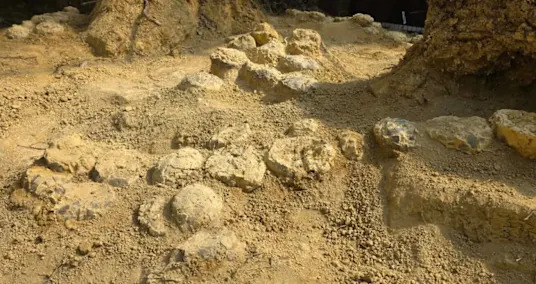
Imagine brushing away 72 million years of sediment and uncovering hundreds of dinosaur eggs, their shells still intact after surviving everything from asteroid impacts to ice ages. That’s exactly what happened at the Mèze fossil site in southern France, where paleontologists working through the winter months revealed one of the world’s most significant dinosaur nesting grounds. The discovery feels like stumbling upon a prehistoric treasure trove—if ancient titanosaurs had curated their own museum exhibits.
Ancient Nursery Preserved in Stone
Museum director calls the find an unprecedented gathering of fossilized eggs.
Alain Cabot, director-curator of the Musée-Parc des Dinosaures de Mèze, described the discovery as an “exceptional concentration” spanning 15 square miles of Upper Cretaceous rock. Over 100 eggs became visible within weeks of careful excavation, with many retaining their internal structures—a paleontologist’s equivalent of finding unopened time capsules. The fossil-rich layer extends far beyond the current dig site, suggesting this ancient maternity ward holds many more secrets waiting 70-72 million years for their moment in the spotlight.
A Snapshot of Cretaceous Family Life
Titanosaurs dominated the nesting ground, but smaller dinosaurs also called it home.
The eggs primarily belong to titanosaurs—those massive long-necked herbivores that would dwarf modern elephants. Yet scattered among these giants are smaller treasures:
Eggs from ankylosaurs
Tiny theropods, including the rare Prismatoolithus caboti, one of the smallest carnivorous dinosaur eggs ever discovered
Picture a Cretaceous suburbia where different species chose the same prime real estate for raising their young, much like how modern birds flock to protected wetlands during nesting season.
Modern Wonder Meets Ancient Mystery
Social media buzz reflects enduring fascination with dinosaur discoveries.
The museum’s Facebook announcement exploded with over 1,500 reactions and hundreds of shares, proving dinosaurs still captivate imaginations across generations. Visitors can now observe the ongoing excavation in person, watching scientists methodically reveal creatures that nested here when flowering plants were still evolutionary newcomers. The preserved floodplain environment—where periodic flooding rapidly buried eggs under protective sediment—created perfect fossilization conditions that geological time couldn’t destroy.
Each egg represents a moment frozen in deep time, waiting 72 million years for someone to rediscover the story of these ancient parents and their hopes for the next generation.
From the coolest cars to the must-have gadgets, GadgetReview’s daily newsletter keeps you in the know. Subscribe - it’s fun, fast, and free.
latest_posts
- 1
 'Supergirl' drops 1st teaser trailer: Watch Milly Alcock as Kara Zor-El and the return of Krypto the Superdog
 - 2'Dancing With the Stars' Season 34 finale: Who might win the mirror ball trophy? Where do the remaining contestants rank?
- 3How did humans evolve, and will we evolve more?
- 4Thousands of New York City nurses set to strike Monday if deal isn't reached with hospitals
- 5Will your baby get a hep B vaccine? What RFK panel's ruling means.


- How to watch NASA's Artemis 2 astronauts launch to the moon on April 1
- Trial of pro-Palestine activist begins
- ICAS calls for clearer safeguards in FRC’s TCA policy
- Most loved Seared Chicken: Which Chain Rules?
- A Gastronomic Experience in Healthy Enjoyments: A Survey of \Nutritious and Tasty\ Solid Cooking Recipe Book
- A definitive Bike Standoff: Decision in favor of Your Number one Ride
- Discovery of massive spider's web in Greece reveals unexpected behavior
- The most effective method to Pick the Best Wellbeing Highlights for Seniors in SUVs
- Benin coup thwarted by loyalist troops, president tells nation